Summary
Electromagnetic Stirring (EMS) has emerged as one of the most transformative technologies in modern metallurgy. By applying controlled electromagnetic forces to molten metal during the continuous casting process, EMS dramatically improves the internal quality of cast products — reducing segregation, porosity, and inclusions while enhancing the homogeneity of the final structure. At Samrudhi Engineers, we believe that EMS is not just an upgrade to the casting process — it is a paradigm shift in how high-quality metals are produced. This blog explores the science, benefits, applications, and future of EMS technology in continuous casting.
Introduction: The Challenge of Continuous Casting
Continuous casting is the backbone of modern steel and aluminum production. It is the process by which molten metal is solidified into a semi-finished billet, bloom, or slab for subsequent rolling in finishing mills. The process is efficient and cost-effective — but it comes with inherent challenges. As molten metal solidifies from the outside in, it creates a mushy zone where temperature gradients, solidification rates, and alloy composition can vary significantly. This uneven solidification often results in defects such as centre segregation, porosity, shrinkage cavities, and non-metallic inclusions — all of which compromise the mechanical properties and overall quality of the final product.
For decades, metallurgists and engineers sought solutions to these problems. Electromagnetic Stirring emerged as the answer — a non-contact, highly controllable method of agitating molten metal to produce cleaner, more uniform cast products.
What Is Electromagnetic Stirring (EMS)?
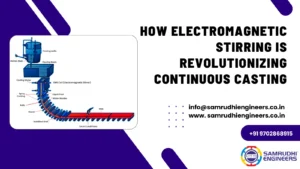
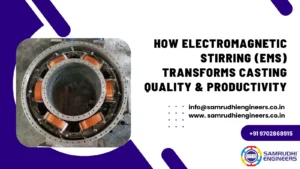
Electromagnetic Stirring uses the principles of electromagnetic induction to generate controlled fluid flow within liquid or semi-liquid metal. A rotating or travelling magnetic field is applied externally through specially designed coils installed around the mould, strand, or final solidification zone. This magnetic field induces electric currents within the electrically conductive molten metal, and these currents interact with the magnetic field to produce Lorentz forces — forces that set the melt in motion.
The resulting stirring effect is remarkably effective. Without any physical contact with the melt, EMS can control the velocity, direction, and intensity of metal flow — making it a precise and clean alternative to mechanical stirring or other agitation methods.
Types of EMS in Continuous Casting

Mould EMS (M-EMS): Installed around the mould, M-EMS acts on the initial solidification stage. It promotes an equiaxed solidification structure, breaks up dendrites, and reduces inclusion entrapment near the surface of the cast strand.
Strand EMS (S-EMS): Applied in the secondary cooling zone, S-EMS targets the mushy zone of the solidifying strand. It helps push solute-enriched liquid out of the centre, reducing centreline segregation and improving macrostructure.
Final EMS (F-EMS): Positioned near the solidification end point, F-EMS improves the equiaxed zone at the core of the product. It is especially effective for reducing centre porosity and point segregation in large blooms and round billets.
How EMS Is Revolutionizing Continuous Casting
1. Superior Metal Quality
Perhaps the most significant benefit of EMS is its direct impact on metal quality. Traditional continuous casting often produces a columnar grain structure with a strongly segregated centre. EMS disrupts this columnar growth, promoting the formation of equiaxed grains throughout the cross-section. Equiaxed grains are more uniform, isotropic, and mechanically superior. The result is a cast product with improved tensile strength, better ductility, and higher resistance to fatigue and fracture.
2. Reduction in Casting Defects
EMS significantly reduces the formation of critical defects that plague conventional casting. Centre segregation — the uneven distribution of alloying elements in the core — is reduced as EMS promotes better mixing in the mushy zone. Porosity and shrinkage voids, caused by insufficient liquid metal feeding during solidification, are minimized. Non-metallic inclusions, which weaken the steel and cause surface defects in downstream processing, are also reduced as EMS helps float them out of the melt. For high-grade steel producers, this translates directly into lower rejection rates, reduced scrap, and higher yield.
3. Enhanced Productivity and Process Control
EMS offers significant advantages in process flexibility. By adjusting the frequency and intensity of the electromagnetic field, operators can precisely tune the stirring effect to match the specific alloy being cast, the casting speed, and the desired product quality. Modern EMS systems come integrated with advanced automation and monitoring tools, enabling real-time feedback and control. This level of process control was simply not possible with earlier casting technologies. Plants can now run at higher casting speeds without compromising quality, directly boosting productivity.
4. Energy and Cost Efficiency
While EMS systems require an initial capital investment, the long-term economic benefits are compelling. Reduced defect rates mean less rework, fewer customer rejections, and lower material costs. Improved yield from each heat translates to a direct bottom-line benefit. Additionally, because EMS reduces the need for downstream remediation — such as additional rolling or heat treatment to correct internal defects — energy consumption across the entire production chain is reduced.
5. Enabling Advanced Alloy Production
As demand grows for high-performance steels and specialty alloys used in automotive, aerospace, and energy sectors, EMS has become an enabling technology. Many advanced grades — high-carbon steels, bearing steels, tool steels, and stainless steels — have stringent internal quality requirements that are simply unachievable without EMS. Samrudhi Engineers has observed a sharp rise in demand for EMS solutions from producers expanding into premium steel grades, underlining the technology’s strategic importance.
Applications Across Industries
EMS technology is widely applied across several sectors:
- Steel manufacturing — for billets, blooms, and slabs in long products and flat products mills
- Aluminium and non-ferrous casting — for improved ingot quality and reduced hot-tearing
- Specialty alloy production — for bearing steels, rail steels, tool steels, and stainless grades
- Forging stock preparation — where internal soundness is critical for high-integrity components
Samrudhi Engineers: Your EMS Partner
At Samrudhi Engineers, we are committed to bringing the most advanced electromagnetic stirring solutions to steel plants and foundries across India and beyond. Our team combines deep metallurgical expertise with engineering excellence to deliver EMS systems that are precisely calibrated to your casting machine, alloy mix, and production goals.
We offer end-to-end support — from feasibility studies and system design to installation, commissioning, and after-sales service. Our EMS solutions have helped customers achieve measurable improvements in quality ratings, customer satisfaction scores, and operational efficiency. We understand that every plant is unique, and our approach is always customized, collaborative, and results-driven.
The Future of EMS: Smart and Sustainable Casting
The future of EMS is deeply intertwined with the digitalization of the steel industry. Next-generation EMS systems are being integrated with AI-driven process models, digital twins of casting machines, and real-time quality prediction tools. These smart EMS platforms can automatically optimize stirring parameters based on incoming sensor data, ensuring consistent quality even as process variables shift.
Sustainability is also a major driver. By reducing scrap, lowering energy usage, and minimizing the need for downstream processing, EMS contributes directly to greener steel production — a priority that is reshaping investment decisions across the global metals industry. For forward-thinking producers, EMS is not just a quality tool — it is a strategic asset.
Conclusion
Electromagnetic Stirring has evolved from a niche metallurgical tool into a cornerstone technology for high-quality continuous casting. It addresses the fundamental challenges of solidification — defects, segregation, and poor internal structure — with precision, reliability, and efficiency. Whether you are a large integrated steel producer or a specialty alloy caster, EMS offers a clear path to better products, lower costs, and stronger competitiveness. At Samrudhi Engineers, we are proud to be part of this transformation. If you are exploring EMS solutions for your casting operation, we invite you to connect with our team and discover how we can help you cast better, smarter, and cleaner.
Frequently Asked Questions (FAQ)
Electromagnetic Stirring (EMS) is a technology that uses externally applied rotating or travelling magnetic fields to induce controlled fluid motion in molten metal during the continuous casting process. This non-contact stirring method improves metal homogeneity, reduces defects, and enhances the internal quality of cast products.
EMS can be applied at three key locations: in the mould (M-EMS) to affect early solidification, in the secondary cooling zone (S-EMS) to address the mushy zone, and near the final solidification point (F-EMS) to improve the equiaxed zone at the core. The choice of EMS type depends on the specific quality goals and the type of cast product.
EMS is effective in reducing centre segregation, porosity, shrinkage cavities, columnar grain growth, and non-metallic inclusion entrapment. All of these defects can negatively affect the mechanical properties and performance of the final product.
EMS is most widely used in steel production, particularly for billets, blooms, and slabs. It is also applied in aluminium and non-ferrous metal casting. The technology is especially valuable for specialty and high-grade alloys where internal cleanliness and structural uniformity are critical.
EMS allows producers to increase casting speed without sacrificing product quality. It also reduces rejection rates and the need for downstream rework, leading to higher effective yield and lower overall production costs.