Summary
Copper quality plays a crucial role in EMS coil manufacturing by influencing electrical conductivity, heat management, energy efficiency, and equipment reliability. Samrudhi Engineers highlights the importance of selecting suitable high-conductivity copper, maintaining precise winding dimensions, and following effective quality control practices. Using appropriate materials and manufacturing processes can help reduce electrical losses, minimize maintenance requirements, and improve coil performance and service life in industrial applications.
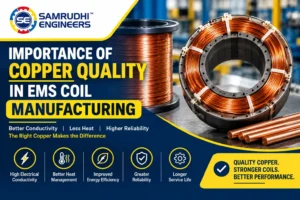
Copper quality plays a vital role in electromagnetic system (EMS) coil manufacturing, directly influencing electrical conductivity, heat generation, energy efficiency, and equipment reliability. For industries that depend on consistent electromagnetic performance, selecting the right copper material is essential for achieving long-term operational efficiency.
At Samrudhi Engineers, quality-focused engineering practices and reliable coil-related solutions are important considerations for industrial applications. Understanding the role of copper in EMS coil manufacturing helps businesses make informed decisions when selecting coils for their equipment and operational requirements.
Copper is widely used in electromagnetic coil manufacturing because of its excellent electrical conductivity, thermal properties, ductility, and ability to be formed into precise windings. However, variations in copper purity, conductor dimensions, and material consistency can affect the performance of the finished coil.
In this blog, we explore the importance of copper quality in EMS coil manufacturing, its impact on coil performance, essential quality control practices, and the factors businesses should consider when choosing an EMS coil manufacturer.
What Is an EMS Coil?
An EMS coil is an electromagnetic coil designed to generate a magnetic field when electrical current passes through its conductive winding. Depending on the application, EMS coils can be used in industrial electromagnetic systems, automation equipment, material handling, and other specialized applications.
An EMS coil typically consists of copper windings, electrical insulation, and supporting structural components. Its performance depends on several factors, including conductor quality, winding design, operating current, frequency, insulation, and cooling arrangements.
For manufacturers such as Samrudhi Engineers, selecting appropriate materials and maintaining consistent manufacturing quality are important considerations in delivering reliable industrial coil solutions.
1. High Electrical Conductivity Improves EMS Coil Efficiency
Electrical conductivity is one of the most important properties of copper used in EMS coil manufacturing. Copper with suitable high conductivity allows electrical current to flow efficiently, reducing resistance-related power losses.
When winding resistance is unnecessarily high, more electrical energy is converted into heat. Using copper that meets the required conductivity specifications can help minimize these losses and support efficient coil operation.
The resistance of a conductor depends on its resistivity, length, and cross-sectional area:
R = ρ × L / A
Here, R represents resistance, ρ represents electrical resistivity, L is conductor length, and A is its cross-sectional area.
At Samrudhi Engineers, material selection and suitable engineering specifications are important considerations for industrial coil applications. Selecting the right copper grade and conductor dimensions helps ensure that the winding is appropriate for its intended operating conditions.
2. Effective Heat Management and Temperature Control
Heat generation is a major consideration in EMS coil manufacturing. When electrical current passes through copper windings, some energy is lost as heat because of the conductor’s electrical resistance.
Excessive heat can accelerate insulation ageing, affect electrical reliability, and increase the possibility of premature coil failure.
Copper has excellent thermal conductivity, which helps distribute heat through the conductor. However, effective temperature control also depends on winding design, current density, cooling arrangements, insulation materials, and operating conditions.
Samrudhi Engineers recognizes the importance of suitable engineering practices in industrial coil applications, where thermal management and operating reliability must be considered together.
Choosing appropriate copper specifications and ensuring that the complete coil design supports adequate cooling can help maintain temperatures within the required operating limits.
3. Reduced Energy Losses and Operating Costs
Energy efficiency is an important factor for industrial facilities that operate electrical and electromagnetic equipment for extended periods.
The resistive power loss in a coil can be calculated using:
P = I²R
In this formula, P is power loss, I is electrical current, and R is winding resistance.
Because power loss increases with the square of the current, controlling winding resistance is especially important in high-current applications.
Suitable high-conductivity copper can help reduce resistance-related losses when conductor dimensions and operating conditions are comparable. Over time, this may contribute to improved energy efficiency and reduced operating expenses.
For industrial customers evaluating EMS coil solutions from Samrudhi Engineers, it is important to consider conductor specifications, operating requirements, and overall system efficiency rather than evaluating equipment solely on its initial purchase price.
4. Better Mechanical Reliability and Winding Quality
Copper conductors must withstand bending, shaping, winding, and other manufacturing processes. The material should have suitable mechanical properties to support accurate winding without unnecessary cracking or deformation.
Inconsistent conductor dimensions, surface defects, or unsuitable material properties can create manufacturing challenges and increase material waste.
Reliable EMS coil manufacturing requires appropriate copper selection, dimensional accuracy, controlled winding procedures, and suitable insulation application.
These practices help improve manufacturing consistency and support the structural integrity of the finished coil.
Samrudhi Engineers aims to address industrial engineering requirements through quality-conscious practices and attention to application-specific needs. For any coil-related project, checking material suitability and manufacturing specifications is an important step toward achieving dependable performance.
5. Consistent Performance Under Different Operating Conditions
EMS coils may operate under different electrical loads, frequencies, and temperature conditions. The copper conductor must therefore be selected according to the equipment’s intended application.
Higher operating currents can increase heat generation, while higher frequencies may introduce skin and proximity effects that influence effective winding resistance.
The appropriate conductor size, winding arrangement, and cooling system depend on the specific design requirements.
Selecting copper that meets the required electrical and dimensional specifications helps manufacturers develop coils suitable for their intended operating conditions.
For businesses seeking industrial coil solutions, Samrudhi Engineers recommends evaluating the complete application requirements, including electrical ratings, operating frequency, thermal limits, and installation conditions, before selecting a suitable solution.
6. Longer Service Life and Reduced Maintenance
The service life of an EMS coil depends on conductor quality, insulation performance, winding construction, operating conditions, and maintenance practices.
Suitable copper can help maintain appropriate electrical resistance and support effective thermal performance. Conversely, unsuitable material or incorrect conductor dimensions may contribute to excessive heating and reduced efficiency.
When combined with proper insulation, effective cooling, accurate winding, and appropriate electrical testing, good-quality copper can contribute to improved coil reliability.
For industrial facilities, dependable equipment helps reduce avoidable maintenance, unplanned downtime, and replacement expenses.
When evaluating coil manufacturing or related engineering services from Samrudhi Engineers, businesses should consider manufacturing quality, application compatibility, testing procedures, and long-term operational requirements.
7. Copper Purity and Material Consistency
Copper purity is an important factor in electrical conductor performance. High-conductivity copper grades are commonly used in electrical applications because they offer suitable electrical properties.
Material composition and processing can influence conductivity, mechanical properties, and consistency. Manufacturers should therefore source copper from reliable suppliers and verify that it meets the required material specifications.
Important quality checks may include:
Copper grade and material certification
Electrical conductivity or resistivity
Wire diameter, strip thickness, and cross-sectional dimensions
Surface condition and visible defects
Mechanical properties where required
Insulation compatibility and finished-coil testing
These checks help establish material traceability and improve manufacturing consistency.
For quality-focused industrial engineering, Samrudhi Engineers understands the importance of considering material specifications as part of a complete approach to dependable equipment performance.
8. Importance of Quality Control in EMS Coil Manufacturing
High-quality copper is essential, but material selection alone cannot guarantee a reliable EMS coil. A structured quality assurance process is equally important.
A comprehensive quality control process may include the following steps:
Material inspection: Verify copper specifications, dimensions, supplier documentation, and surface condition.
Winding preparation: Follow approved procedures for conductor handling, bending, and winding.
Insulation inspection: Ensure that insulation materials are suitable for the intended operating voltage and temperature.
Dimensional verification: Check winding geometry, conductor positioning, and specified tolerances.
Electrical testing: Conduct applicable continuity, winding resistance, insulation resistance, and dielectric withstand tests according to the design and relevant standards.
Final performance verification: Where required, evaluate operating temperature, electrical ratings, and electromagnetic performance against approved specifications.
For customers considering Samrudhi Engineers for industrial coil-related requirements, understanding the manufacturer’s quality control procedures can help them evaluate product suitability and expected performance.
9. How to Choose the Right EMS Coil Manufacturer
Selecting the right manufacturer is as important as choosing the right copper. Industrial buyers should assess the manufacturer’s ability to understand application requirements, follow suitable engineering practices, and maintain consistent quality.
Before choosing an EMS coil manufacturer, consider these factors:
Material specifications: Confirm that copper grade and conductivity meet the application requirements.
Engineering expertise: Evaluate the manufacturer’s understanding of electrical, thermal, and mechanical requirements.
Manufacturing precision: Check whether conductor dimensions, winding arrangements, and insulation procedures follow approved specifications.
Quality assurance: Ask about applicable inspection procedures and electrical test reports.
Application suitability: Ensure the coil is designed for the required current, frequency, temperature, and duty cycle.
Technical support: Consider the availability of guidance for installation, operation, and maintenance.
Samrudhi Engineers provides an industrial engineering context for businesses seeking coil-related solutions. Customers should discuss their technical specifications and operating requirements to determine the most suitable solution for their equipment.
10. Why Copper Quality Is a Long-Term Investment
Choosing copper based only on its initial cost can overlook important long-term considerations. Unsuitable materials may contribute to higher electrical losses, manufacturing defects, or additional maintenance requirements.
Using copper that meets the required specifications, alongside proper engineering and manufacturing practices, can help improve electrical performance, control heat generation, and support reliable operation.
The overall financial benefits depend on operating hours, electrical load, energy prices, cooling arrangements, maintenance requirements, and the complete coil design.
For this reason, industrial buyers should evaluate material quality as part of a lifecycle-cost approach.
By considering conductor specifications, manufacturing quality, and application requirements, businesses can make more informed decisions when selecting industrial coil solutions.
Conclusion
Copper quality is a fundamental consideration in EMS coil manufacturing because it influences electrical conductivity, winding resistance, heat generation, mechanical reliability, and operating efficiency. Choosing suitable copper and implementing effective quality control practices can help improve coil consistency and support dependable industrial performance.
However, reliable EMS coils require more than good-quality copper. Correct winding design, suitable insulation, effective cooling, accurate manufacturing, and appropriate testing are equally important.
Samrudhi Engineers understands the importance of quality-conscious engineering practices in industrial applications. When selecting EMS coil solutions, businesses should evaluate material specifications, manufacturing procedures, and technical suitability to support reliable equipment operation.
For industrial coil-related requirements, connect with Samrudhi Engineers to discuss your application needs and determine an appropriate solution based on your technical specifications.
Frequently Asked Questions
Copper quality affects electrical conductivity, winding resistance, heat generation, and manufacturing consistency. Suitable copper helps support efficient and reliable coil performance when combined with proper design and quality control.
High-conductivity electrical copper is commonly used for coil windings. The exact grade depends on the operating current, frequency, conductor dimensions, temperature limits, and design specifications.
Copper purity and composition influence electrical conductivity. Suitable high-conductivity copper can help reduce winding resistance and resistive losses when other conditions remain comparable.
Unsuitable copper may contribute to higher resistance and additional heat generation. Overheating can also result from excessive current, insufficient cooling, incorrect winding dimensions, or insulation problems.
Samrudhi Engineers is an industrial engineering business. Customers interested in EMS coil-related solutions should discuss their application requirements and confirm the relevant product specifications, manufacturing capabilities, and testing procedures directly with the company.
Visit the official Samrudhi Engineers website to review its industrial engineering services and use the published contact details to discuss your application, technical specifications, and service requirements.